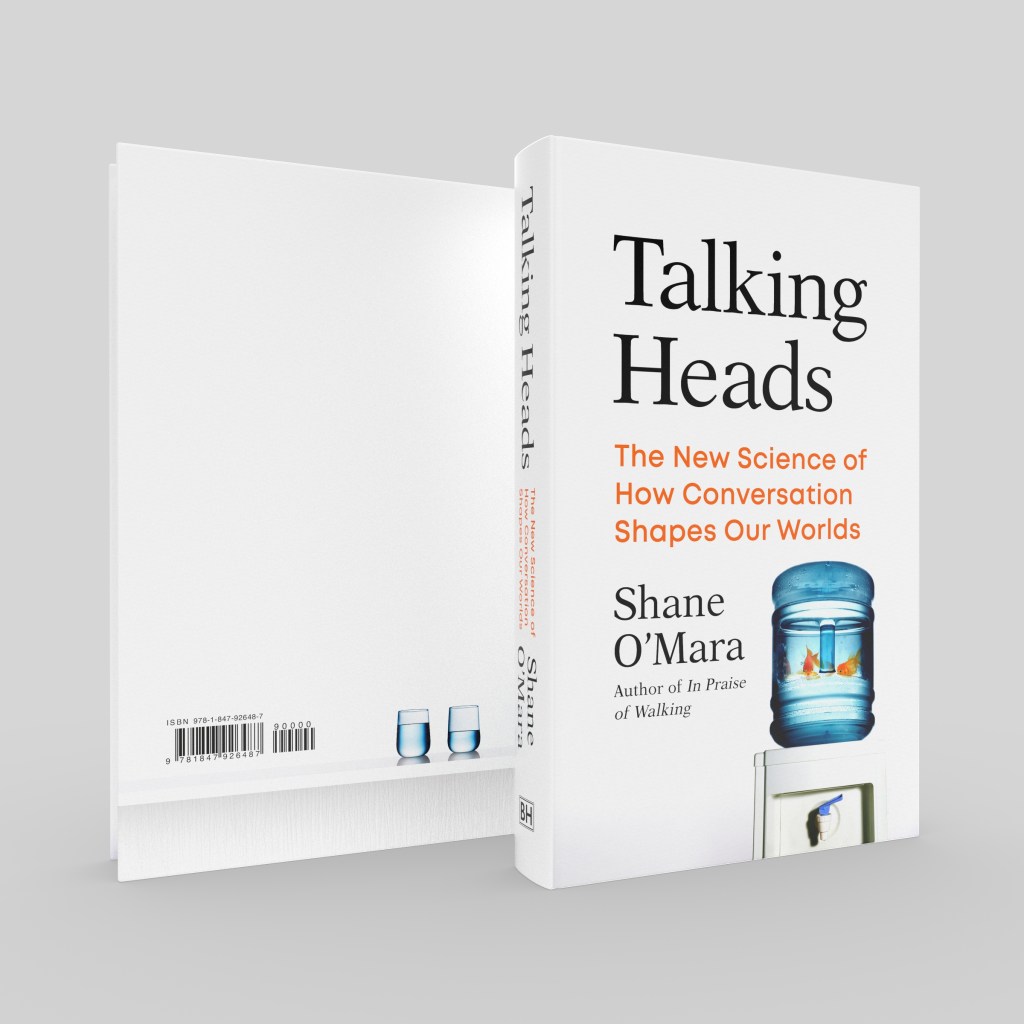
Talking Heads: The New Science of How Conversation Shapes Our Worlds (2023)
Hodges Figgis Book of the Month; a Waterstones science book of the year (2023)
We are social animals and talking is part of what makes us human.
But what purpose does conversation serve? In this revelatory tour of talking, neuroscientist Shane O’Mara explores why we communicate, what happens in our brains when we do it, and what it means for us as individuals, groups and societies.
How do our thoughts, memories, and conversations change our brains? What does it mean that we spend most of our thinking lives in a five-minute bubble around the present moment? Why does our sense of self solidify with age, even as we grow more forgetful? In what ways do we imagine futures together? And how do our nations begin as conversations?
Moving from the personal to the social and ultimately towards a radical new perspective on the defining phenomenon of our times, populist nationalism, this is the story of how conversation builds the worlds around us – and how, together, we can talk our way into a better tomorrow.
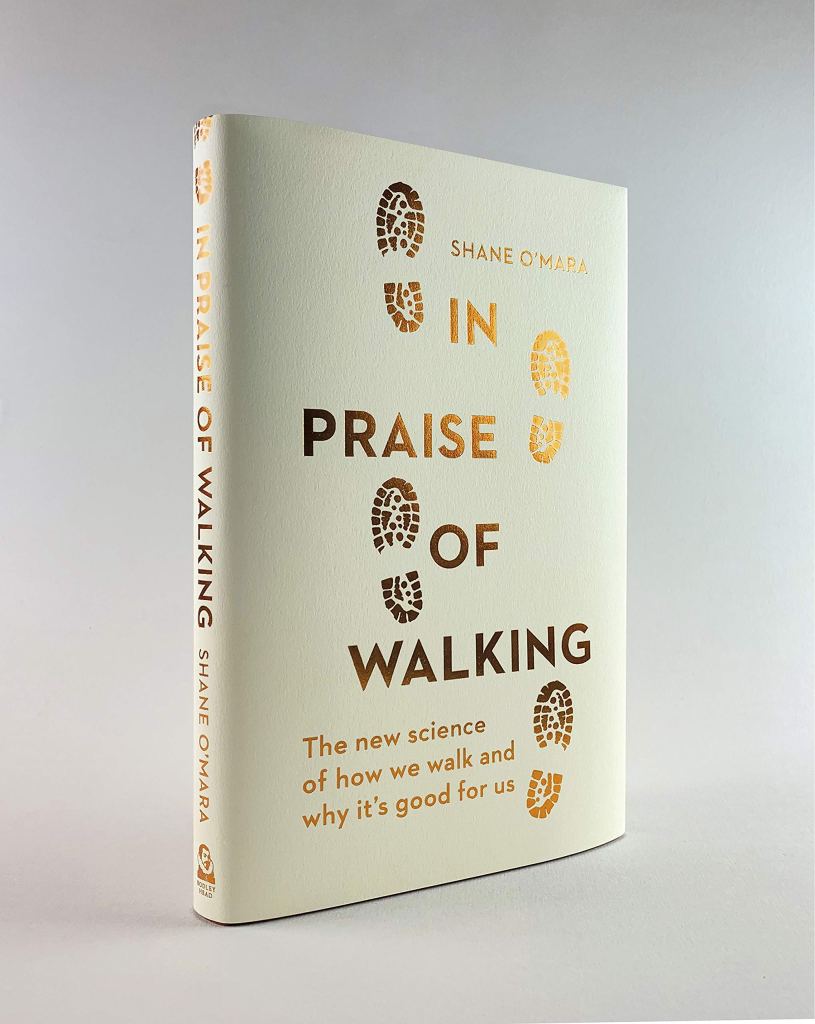
In Praise of Walking: The New Science of How We Walk and Why It’s Good for Us
(PenguinRandomHouse/Bodley Head/Vintage; WW Norton; Amazon; Trans: (2020/21: French, Dutch, Spanish, Norwegian, Russian, Chinese, Greek, German, Polish, Italian, Slovenian, Romanian). ‘In Praise of Walking’ was chosen by the editors of Amazon.com as one of the best science books of 2020.
In this “wonderful” (John Brandon, Forbes) book, neuroscientist Shane O’Mara invites us to marvel at the benefits walking confers on our bodies and brains, and to appreciate the advantages of this uniquely human skill. From walking’s evolutionary origins, traced back millions of years to life forms on the ocean floor, to new findings from cutting-edge research, he reveals how the brain and nervous system give us the ability to balance, weave through a crowded city, and run our “inner GPS” system. Walking is good for our muscles and posture;?it helps to protect and repair organs, and can slow or turn back the aging of our brains. With our minds in motion we think more creatively, our mood improves, and stress levels fall. Walking together to achieve a shared purpose is also a social glue that has contributed to our survival as a species.
As our lives become increasingly sedentary, O’Mara makes the case that we must start walking again―whether it’s up a mountain, down to the park,?or simply to school and work. In Praise of Walking?illuminates the joys, health benefits, and mechanics of walking, and reminds us to get out of our chairs and discover a happier, healthier, more creative self.
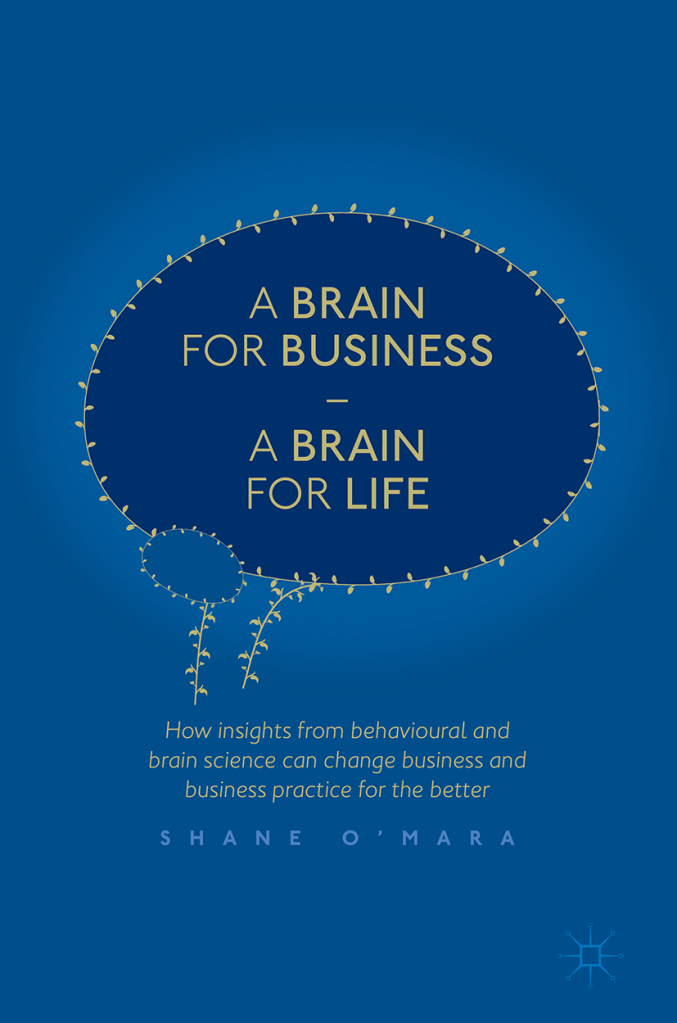
A Brain for Business – A Brain for Life
(published by PalgraveMacmillan, 2017)
Behaviour change is hard, but O’Mara shows that by adopting strategies that are well-founded in the science of brain and behaviour individuals and organisations can adapt to the demands of the modern world.
The brain matters in business. The problem is that our brains have many biases, heuristics and predilections that can distort behaviour and decision making. The good news is that we know more about how these work than ever before.
O’Mara’s starting point is that, as our behaviour arises from the structure and function of our brains, careful examination of a series of brain–based (‘neurocognitive’) analyses of common aspects of human behaviour relevant to business and management practice reveals lessons that can be used at work.
He begins by looking at neuroplasticity and how it is enables a shift from a restrictive ‘fixed mindset’ to an enabling ‘growth mindset’. He shows how this changing mindset approach – where the focus is on task and improvements based on effort – is scalable within organisations.
Next, as the brain is a living organ like the heart and lungs, O’Mara shows how to keep it physically in the best possible shape before examining how we exercise control over our behaviour, build resilience and create positive brain states. He also considers the implications for business of our brains wiring for status and illustrates how research shows that it is possible to de-bias assumptions about gender and race – and the impact that this has on performance.

Why Torture Doesn’t Work: The Neuroscience of Interrogation
(Harvard University Press, 2015)
Torture is banned because it is cruel and inhumane. But as Shane O’Mara writes in this account of the human brain under stress, another reason torture should never be condoned is because it does not work the way torturers assume it does.
In countless films and TV shows such as Homeland and 24, torture is portrayed as a harsh necessity. If cruelty can extract secrets that will save lives, so be it. CIA officers and others conducted torture using precisely this justification. But does torture accomplish what its defenders say it does? For ethical reasons, there are no scientific studies of torture. But neuroscientists know a lot about how the brain reacts to fear, extreme temperatures, starvation, thirst, sleep deprivation, and immersion in freezing water, all tools of the torturer’s trade. These stressors create problems for memory, mood, and thinking, and sufferers predictably produce information that is deeply unreliable—and, for intelligence purposes, even counterproductive. As O’Mara guides us through the neuroscience of suffering, he reveals the brain to be much more complex than the brute calculations of torturers have allowed, and he points the way to a humane approach to interrogation, founded in the science of brain and behavior.
Torture may be effective in forcing confessions, as in Stalin’s Russia. But if we want information that we can depend on to save lives, O’Mara writes, our model should be Napoleon: “It has always been recognized that this way of interrogating men, by putting them to torture, produces nothing worthwhile.”
 Shane O'Mara Writer